
Carl Orff never did what others thought was right or wanted him to do – an individualist who had no interest in classical genres such as symphonies, string quartets, or concertos.
In 1934, the almost 40-year-old Orff was searching for a subject that would help him achieve his major breakthrough. “Fortune had been kind to me,” he later admitted. In a Würzburg antiquarian book catalog, he discovered a title that “attracted him with magical force.” He was referring to the collection “Carmina Burana,” with song and drama texts, drinking songs and love songs, both moral and satirical, a European compendium from the Middle Ages. The authors of the texts are mostly unknown. The only surviving manuscript dates from around 1230.
This book celebrates life, love, and Eros. It also contains a lament about the work of the capricious goddess Fortuna, the goddess of luck.
Orff seeks statements in Carmina Burana that transcend the musical. But he also finds texts that are at the heart of life: “Estuans interius” is an uninhibited appreciation of this world, a feasting and drinking orgy of monks and abbots.
During one phase—recently divorced and short of money—Orff begins his composition with almost feverish zeal. After just one day and one sleepless night, the sketches for the opening chorus are finished. The rest of the work spans the years 1935 and 1936. The premiere of Orff’s Carmina Burana took place on June 8, 1937, at the Frankfurt Opera.
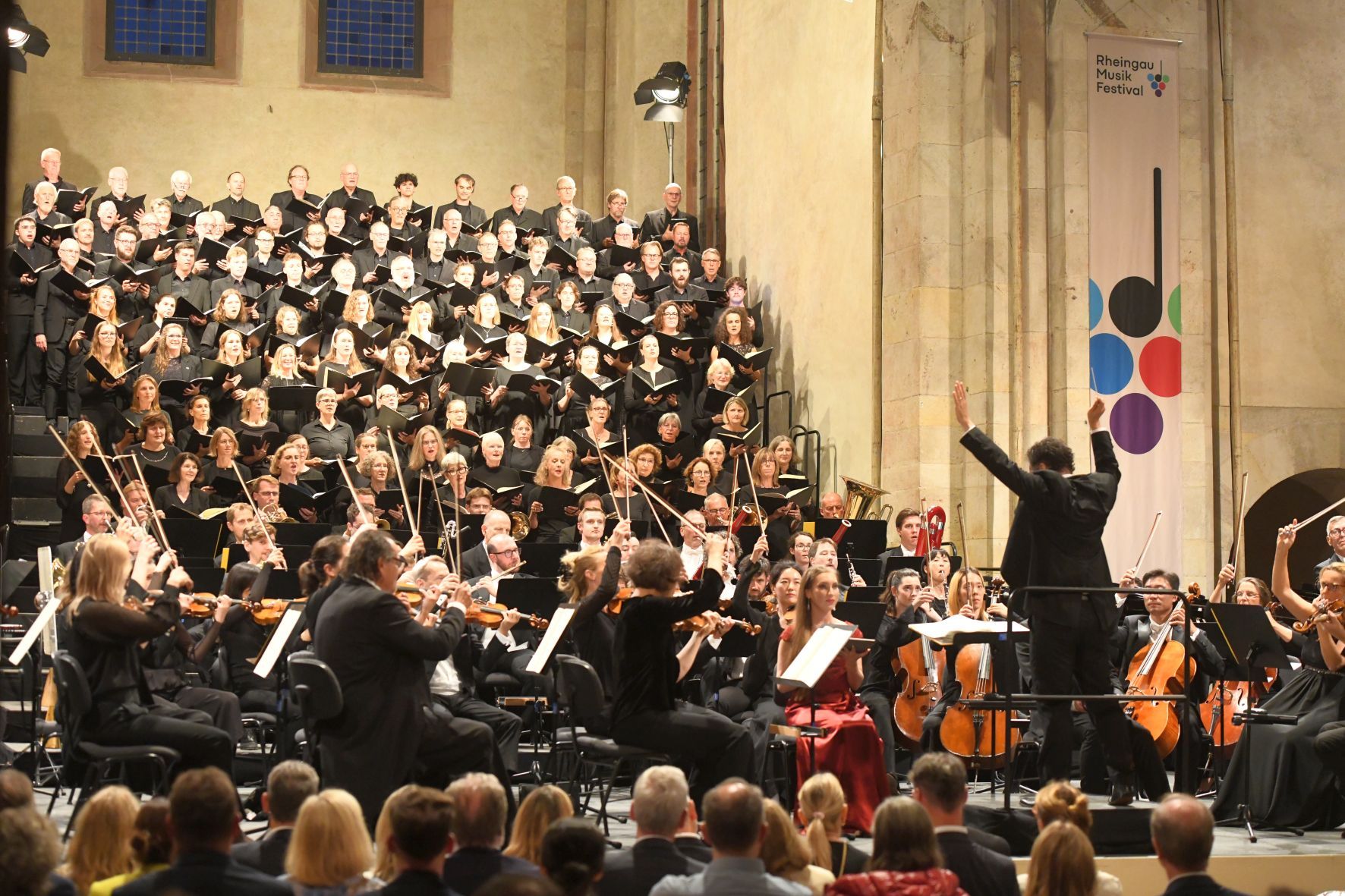
Orff writes music that contains captivating melodies, sophisticatedly orchestrated with colorful orchestral sounds, and animated by striking rhythms. This paved the way for his later success: whether with Michael Jackson, with today’s rappers, in cinema history, as soundtrack for boxing matches or commercials. Orff’s music captivates a wide audience. This is especially true of the introductory “O Fortuna,” the hymn-like opening chorus, a musical powerhouse, much heard, much reviled, and much loved. With this music alone, which Orff places not only at the beginning but also at the end of his Carmina, he achieved a lifelong goal: The most beautiful tribute to a composer is when he remains on the repertoire. As every year, Carmina Burana is also a highlight of the Rheingau Music Festival program.
 And so, this year, Orff’s Carmina Burana was once again received with great enthusiasm by the audience. With frenetic applause and standing ovations, the audience in the basilica of Eberbach Monastery honored and acknowledged the performances of the Gürzenich Orchestra Cologne under the direction of Andres Orozco-Estrada, the Chamber Choir of the University of Cologne, the boys and girls of the Cologne Cathedral Music Citizens’ Choir, the 28-year-old Latvian soprano Annija Adamsone, the tenor Michael Schade, one of the leading tenors of our time, and the internationally sought-after baritone Michael Nagye.
Johanna Wenninger-Muhr